Frec’s appeal is cost and control
Frec pairs a relatively low starting fee with direct indexing, but the $20,000 minimum means it isn’t a starter account for every investor. The service earns a 3.5 out of 5 rating in the review graphic. That score suggests a qualified endorsement, not an obvious winner.

Classic direct indexing requires $20,000 to get started, and annual fees begin at 0.09%. Investors can choose indexes from S&P, Nasdaq, Morningstar, Russell, and MSCI. Frec also offers automated tax-loss harvesting, stock and ETF trading, Treasury investments, and portfolio borrowing. Those tools give investors room to tailor how they manage a portfolio; they also make it important to understand which features fit your goals and how you plan to use them.
What stands out—and what to weigh
The strongest points are low management fees for direct indexing, customization, and automated tax-loss harvesting checks. The trade-off is the $20,000 entry threshold. If you’re comparing services, the headline fee is only part of the decision: the minimum and the features you’ll actually use matter too.
Frec’s tax tools come with trade-offs
The main appeal of Frec is direct indexing: you hold individual stocks that track an index instead of owning an ETF. That gives the platform a chance to sell specific holdings at a loss for tax purposes, even when the portfolio overall has gained value. It’s a useful distinction, though any tax benefit depends on your circumstances and isn’t guaranteed.
Direct indexing has traditionally made the most sense for high-net-worth investors with gains to offset. Frec aims to make it available at lower minimums and fees. The question for you is whether the potential tax savings justify the account cost and the extra complexity.
What Frec offers
Frec is a San Francisco fintech focused on tax-aware investing. Alongside its direct-indexing accounts, it offers self-directed trading, cash investments in Treasury funds, and a line of credit backed by eligible investments. Frec is registered with the SEC and FINRA and says it acts as a fiduciary. Apex Clearing holds customer accounts, and account funds are covered by SIPC insurance.
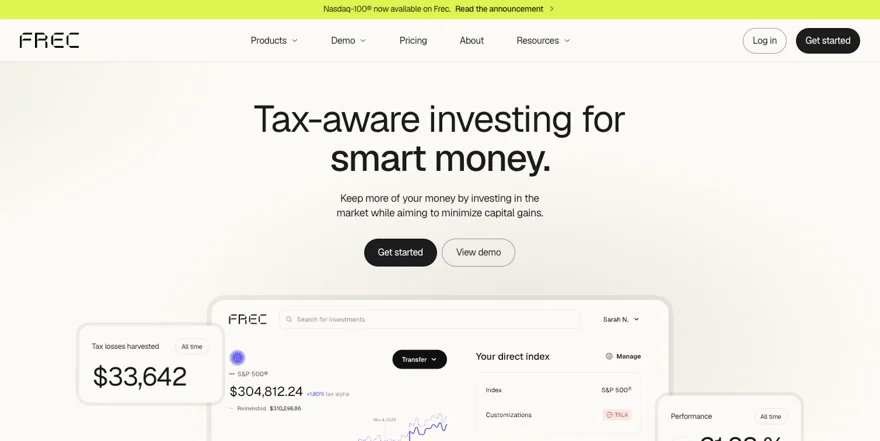
Direct indexing: Classic, Long Short, and Diversify
Frec’s Classic account tracks an index with individual stocks and checks daily for tax-loss harvesting opportunities. You can add, remove, or change the weights of as many as 25 stocks; sector adjustments are available for most indexes. Choices include the S&P 500, S&P 100, S&P 500 Information Technology, S&P 500 Momentum and S&P 500 Shariah indexes, along with developed- and emerging-market ADR indexes. Other available strategies track the Nasdaq-100, Morningstar, Russell, MSCI, Dow Jones, and semiconductor indexes.
Here’s why that structure can matter: an S&P 500 ETF may rise even while some of its component stocks fall. An ETF investor can’t sell those underlying shares individually, but a direct-indexing investor can realize losses on them while keeping the broader strategy in place.
Long Short adds short positions and extra long exposure. A 140/40 portfolio, for example, holds long positions equal to 140% of its equity and short positions equal to 40%, for net exposure near 100%. Investors can choose Growth, Value, or Quality tilts. The design can create more chances to harvest losses, but short selling brings financing costs and the possibility of larger losses.
Diversify is aimed at investors with a large holding in one company, such as employer stock with unrealized gains. Frec builds long and short positions around that holding and seeks to use harvested losses to offset gains as the concentrated position is sold down over time. That may help with taxes, but the outcome depends on market movements and the investor’s tax position. The strategy is more involved than simply selling shares or buying an ETF.
A line of credit against investments
Frec also lets eligible customers borrow against their investments, potentially raising cash without selling assets and realizing a capital gain. The borrowing limit starts at about 50% of portfolio value and may reach 70%. At the time described, the advertised rate was 4.88%, calculated from the Effective Federal Funds Rate plus 1%; it can change as that benchmark moves.
There may be no required monthly payment while the account stays within margin limits. But a falling portfolio can trigger a margin call, forcing you to add assets or repay the loan. If you can’t, securities may be sold. The flexibility can look attractive; borrowing against investments remains a high-risk choice that won’t suit most investors.
Treasury cash and self-directed trading
Frec Treasury invests cash in U.S. Treasury mutual funds and may suit money you expect to invest later or dividends awaiting reinvestment. As of October 15, 2026, Frec advertised a 3.59% yield after its 0.20% annual management fee. The yield is variable, paid monthly, and some fund options require at least $1,000. Funds can be withdrawn within one business day. These investments are not FDIC-insured.
Frec Trade offers commission-free stock and ETF trades with no account minimum. Customers can choose tax lots, place market or day limit orders, and transfer eligible holdings from another brokerage without selling them first. Plaid handles share transfers.
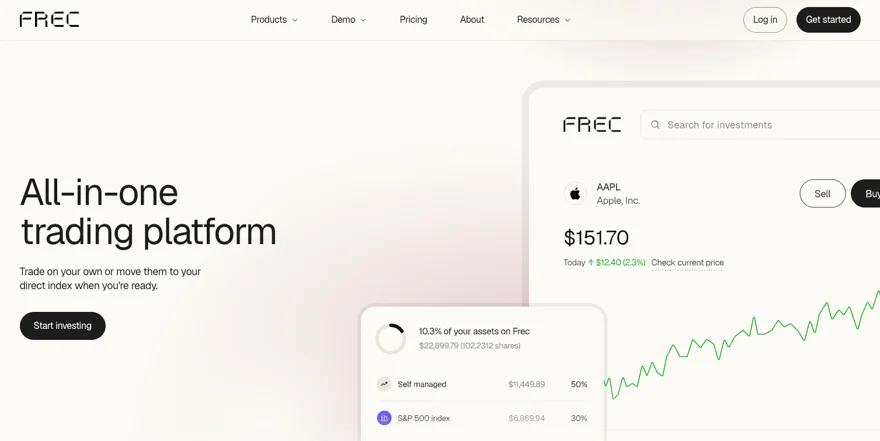
Think of Trade as a way to manage individual investments alongside Frec portfolios, not as a full substitute for a dedicated broker such as Charles Schwab or Fidelity. Keep an eye on trades across accounts: buying a stock while Frec is selling it at a loss could create a wash sale and undermine the tax treatment.
Tax-loss harvesting depends on your full picture
Frec reviews direct-indexing portfolios daily for stocks trading below their purchase price, then can sell those positions and reinvest while maintaining the chosen strategy. Realized losses may offset capital gains. The IRS says excess net capital losses can generally offset up to $3,000 of ordinary income each year ($1,500 for married taxpayers filing separately); unused losses can be carried forward.
Frec can try to prevent wash sales inside its managed portfolios, but it can’t see every trade you make in outside accounts, including a spouse’s accounts. Your results will depend on your tax situation, available gains, market conditions, and fees. The feature can be valuable, but it doesn’t produce a guaranteed tax saving.
Account minimums and annual fees
The price varies sharply by strategy. Classic starts at a lower threshold, while the more complex Long Short and Diversify accounts require substantially more capital and charge higher annual fees.
| Account | Minimum investment | Annual fee |
|---|---|---|
| Classic | $20–$50,000 | 0.09%–0.35% |
| Long Short | $100,000–$500,000 | 0.50%–1.30% |
| Diversify | $100,000–$500,000 | 0.60%–1.10% |
| Treasury | Up to $1,000 | 0.20% |
| Trade (self-directed) | $0 | Zero-commission trading |
How Frec Stacks Up
Frec’s fee and account minimums look appealing beside Wealthfront’s direct indexing offer, but the comparison only tells part of the story: the platforms don’t provide identical services, and Frec users may face other costs. Those include post-tax financing costs in the Long Short and Diversify accounts.
Frec competes with robo-advisors, online brokerages, and other direct indexing platforms. Large firms such as Fidelity and Charles Schwab offer direct indexing, generally through fully managed portfolios designed for a broad range of investors.
Robo-advisors
Tax-loss harvesting is already part of many robo-advisors’ approach, so direct indexing can be a natural extension. Wealthfront offers it, but requires at least $100,000—five times Frec’s minimum—and charges a 0.25% annual fee, or 2.5 times Frec’s stated rate. Betterment offers tax-loss harvesting but not direct indexing. If you’re comparing providers, the minimum and fee differences matter, but so does whether you want direct indexing at all.
 |
 |
 |
|
|---|---|---|---|
| Rating |


