AI’s next investment story may be quantum computing
AI adoption has been strikingly fast: Facebook took about 4.5 years to reach 100 million active users, while ChatGPT did it in two months. The spending behind that shift may be even more consequential. One study projects AI infrastructure investment will average 3.2% of U.S. GDP from 2025 through 2032, a larger share than the railroad and highway buildouts that reshaped the country. That scale makes the next question more than academic: what technology could extend AI’s capabilities? Louis Navellier, who says he has spent more than four decades tracking growth trends, sees quantum computing as a possible next phase. The thesis is promising, but the technology is still early, and the investment case comes with substantial uncertainty. Since ChatGPT launched in November 2022, Nvidia Corp. ( NVDA) has gained more than 1,374%, according to the article. Navellier says readers who bought early benefited, while AI memory and data center stocks have also led the market this year. His view is that the opportunity may broaden as quantum computing advances. McKinsey estimates quantum computing could generate $2.7 trillion in global economic value by 2035. The article doesn’t clarify the estimate’s scope, and that figure shouldn’t be read as a forecast of returns for quantum stocks. Still, it helps explain why investors are watching the field.From microchips to qubits
Navellier frames quantum computing as the next major technology shift after semiconductors, internet leaders, clean energy, cloud software and early AI. His approach has been to use quantitative models to identify emerging trends before they become widely recognized. He says he began discussing quantum computing in summer 2024, describing it as a way to push machine learning and data processing further. At the time, he shared research on early-stage companies as speculative ideas rather than formal portfolio recommendations, in part because many weren’t profitable. The technical distinction is straightforward: conventional computers process information in bits, which represent either one or zero. Quantum computers use qubits, which can represent multiple states at once. That could let them solve some complex problems faster than today’s most powerful computers. For AI, possible applications include more advanced simulations and progress in medicine, energy and materials science. Those are potential uses, not established results. One company Navellier highlighted was Rigetti Computing Inc. (RGTI), which he described as a small company offering cloud access to its own quantum processors. He says he flagged Rigetti in February 2025 and that its shares rose more than 400% by mid-October. The stock later fell back, and he still considers it worth monitoring. That kind of swing captures both the appeal and the risk: quantum stocks can move sharply, and a company’s potential doesn’t remove the possibility of losses.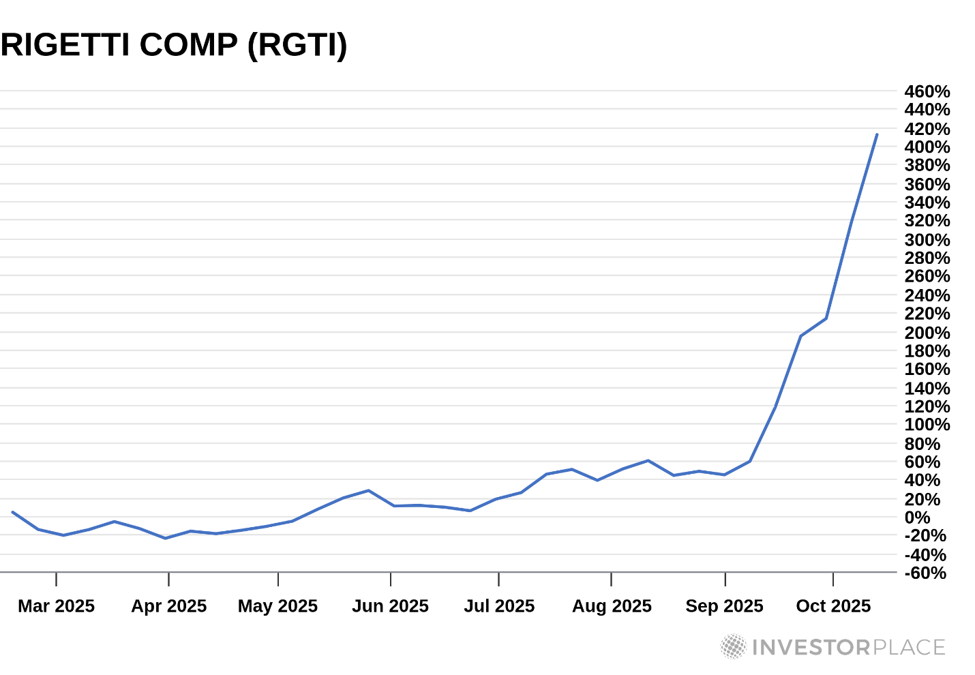
A different way to trade the same theme
Navellier’s colleague Jonathan Rose approached Rigetti from a shorter-term trading perspective. Navellier says his own work focuses on fundamentals and institutional buying that might support a stock over months or years; Rose watches where traders are putting money now. In December 2024, Rose’s system reportedly detected a surge of activity in RGTI, leading to a trade that gained 233% in four days. That result is striking, but one trade doesn’t establish that the strategy will produce similar returns again. Navellier says Rose has more than 25 years of experience, including work as a floor trader at the Chicago Mercantile Exchange and as a market maker at the Chicago Board Options Exchange. During the 2007–2008 financial crisis, Rose made more than $6 million, according to the article, by reading how volatility moved through markets. He later built a community of retail traders around his research and strategies. The distinction is useful for investors: a long-term view of a technology and a short-term trade around market positioning answer different questions. Rose looks for timing, sets a plan for managing risk and considers when to exit. Navellier argues that speculative stocks should be treated as high-risk, high-reward bets and that investors shouldn’t put too much capital behind one. That discipline matters more than the headline gain.Rose’s $10,000 to $100,000 Challenge
Rose is scheduled to host a free event on Wednesday, October 14, at 8 p.m. Eastern: the $10k to $100k Challenge. He plans to explain a trading approach he believes could help everyday investors turn $10,000 into $100,000 or more over the next 12 months. That’s an ambitious target, not a promised outcome. The article says attendees don’t need prior trading experience or $10,000 to attend. Navellier says Rose will discuss how he identifies trades, decides when to act and manages risk. He also says Rose has shown members of Masters in Trading Live how to capture triple-digit gains over days or weeks. Those claims describe past results and the promoter’s view of the strategy; they don’t guarantee future performance. All investing involves risk, and losses are possible. The event is free, and readers can reserve a spot for Jonathan’s $10k to $100k Challenge.Sincerely,

Louis Navellier
Editor, Market 360
The Editor hereby discloses that as of the date of this email, the Editor, directly or indirectly, owns the following securities that are the subject of the commentary, analysis, opinions, advice, or recommendations in, or which are otherwise mentioned in, the essay set forth below:
NVIDIA Corporation (NVDA)
About the analyst
Louis Navellier, editor of Market 360, has advised investors for more than three decades. His reputation rests on growth investing, stock selection and portfolio management. If you want more background on his work, you can read his profile.
The fragment provides no investment conclusion or supporting evidence about the quantum stock mentioned in the article’s URL, so there’s not enough here to assess the reported 233% gain.