
A million dollars is a habit before it’s a headline
The striking part of the million-dollar target is how much time matters. At a 7% annual return, someone starting at 25 would need to invest about $381 a month to reach $1 million by 65. Wait until 35 and the monthly figure rises to $820. A $50,000 salary, a 6% 401(k) contribution and the most common employer match together add up to $375 a month—close enough to put the goal within reach on these assumptions. There’s a catch: a future million dollars won’t have today’s buying power. With inflation averaging 3%, $1 million in 40 years would be worth roughly $307,000 in current dollars. The headline number is a useful milestone, but it shouldn’t be mistaken for a retirement budget. This isn’t a get-rich-quick plan. The case here is that regular saving and long-term investing can build substantial wealth across a range of incomes, given enough time. The author says the original calculations, first published in 2012, still hold up when updated with current 401(k) limits and match data, and reports passing the million-dollar mark in under eight years by following the approach. That personal result is one person’s experience, not a forecast for every investor. The underlying mechanism is compound interest: early contributions have more years to grow, while later starts require much larger deposits. The calculations that follow compare monthly savings needs across starting ages and assumed returns, then turn to practical routes such as workplace retirement plans, IRAs, real estate and business ownership. You can also enter your own assumptions in the millionaire calculator in How To Become A Millionaire At Any Age. The key question is less whether a million is possible than what return, time horizon and contribution level your plan can reasonably support.What the projections assume
Starting from zero and contributing the same amount each month, the model puts the required monthly investment at $655 for a 5% annual return, $381 at 7%, and $286 at 8%, all over 40 years. At 7%, the monthly target climbs to $820 when saving begins at 35, $1,920 at 45, and $5,778 at 55. Those are projections, not promises. The table uses monthly deposits and compounding, and its returns are before taxes, fees and inflation. A higher assumed return lowers the required contribution, but it also makes the outcome more dependent on market performance. The examples are a starting point for planning, not a guarantee that any portfolio will reach the target. | Start saving | Years to 65 | 5% return | 7% return | 8% return | 10% return | |---|---:|---:|---:|---:|---:| | Age 25 | 40 | $655/month | $381/month | $286/month | $158/month | | Age 35 | 30 | $1,202/month | $820/month | $671/month | $442/month | | Age 45 | 20 | $2,433/month | $1,920/month | $1,698/month | $1,317/month | | Age 55 | 10 | $6,440/month | $5,778/month | $5,466/month | $4,882/month | *The calculations assume monthly deposits, monthly compounding and a starting balance of zero. Returns exclude taxes, fees and inflation. Source: The College Investor calculations.* At 5%, the original example’s $650 monthly contribution reaches $991,913; about $655 is needed to cross $1 million. At 8%, $300 a month grows to about $1,047,000, compared with a calculated requirement of roughly $286. The difference between those return assumptions has a large effect over four decades. For a different starting point, the guide to investing in your 30s offers a closer look at beginning later.Planning for returns and time
A 7% planning assumption is deliberately below the roughly 10% annualized S&P 500 return, including dividends, reported for 1928 through 2025 in NYU Stern professor Aswath Damodaran’s annual return data. That margin allows for costs, a portfolio that holds bonds as well as stocks, and the possibility that an investor’s timing won’t match the long-run average. The article’s Rule of 72 explainer shows how different rates affect the time it takes money to double. The historical range is wide. Using the same data, the S&P 500’s weakest 40-year period since 1928 ran from 1929 to 1968 and averaged about 8.5% annually; its strongest, from 1950 to 1989, averaged about 12.5%. History can illustrate what markets have done, but it can’t establish what they’ll return next. That’s why the article points readers toward a low-cost index fund and a cautious planning rate rather than building a retirement plan around the most favorable historical outcome. Its balanced portfolio of stocks and bonds example places a 5% return in the range a mixed portfolio might earn after fees during a weak decade. Starting later changes the arithmetic quickly. At 7%, the 25-year-old contributes $182,880 over 40 years, while a 35-year-old contributes $295,200 over 30 years to reach the same nominal target. Beginning at 45 means putting in $1,920 a month, or $460,800 over 20 years. The last years of compounding do much of the work, as the example of a penny that doubles every day makes clear. For someone who starts at 35, saving just $381 a month instead of the required $820 would produce about $465,000 by age 65 at 7%. That gap is a reason to adjust the plan, not a reason to give up. Revisit the assumptions as your portfolio develops, and use the best retirement calculators to update the estimate. The comparison also shows why beginning early helps: the same monthly contribution has fewer years to compound when you delay.Turning the monthly target into a plan
At age 25, the 7% scenario calls for about $4,572 in annual contributions. The article’s practical case is that a workplace plan, an IRA and additional savings can cover that amount over time. Its first suggested route is the millionaire-next-door approach: consistent contributions, aided by employer matching, rather than a bet on fast gains. Vanguard’s How America Saves 2026 says the most common match in its 401(k) plans is 50 cents for each dollar contributed, up to 6% of pay. For a worker earning $50,000 a year, contributing 6% means putting in $3,000 annually; the employer adds $1,500. That totals $4,500 a year, or $375 a month—nearly the modeled $381 target. Invested for 40 years at 7%, it grows to about $984,000. Raises or a small increase in contributions could close the remaining gap. The guide to 401(k) contribution limits and rules explains the contribution framework, while 15 ways to save an extra $500 per month offers ideas for finding room in a budget. The article also cites Fidelity’s retirement figures: 769,000 people had at least $1 million in a 401(k) at the end of June 2026, up from 654,000 a quarter earlier, while the average 401(k) balance was $155,800, according to Yahoo Finance’s report on Fidelity’s data. Fidelity’s Q2 2026 retirement analysis reported a record average total 401(k) savings rate of 14.4%, and said 81% of participants received their full employer match. Those aggregate figures show that high balances exist, but they don’t tell you what any one worker should expect. Capturing the full match is a practical first step; the retirement savings order of operations lays out where it fits. The 2026 limits provide more room than the basic example requires: the IRS lists a $24,500 employee deferral limit for a 401(k) and a $7,500 IRA contribution limit. At 7%, contributing $24,500 annually to a 401(k) could reach $1 million in about 20 years; investing $7,500 a year in an IRA for 40 years could grow to about $1.64 million. The best IRA accounts guide covers where to open one. As the balance grows and dividends are reinvested, investment returns account for more of the total; the Rule of 72 chart illustrates that compounding pattern. For readers looking for a place to begin, the article offers guides to getting started investing in college, investing in your 20s, and investing in your 30s. Before investing, keep an emergency fund in a high-yield savings account. A car repair or other unexpected bill shouldn’t force you to sell investments or stop contributing.Real estate as another route
Real estate offers another possible path to a million-dollar net worth, and the article’s guide to ways to invest in real estate covers several approaches. Buying property can be difficult when you’re in your 20s and short on cash. House hacking and REIT index funds are two lower-cost options described among these 19 ways to invest in real estate.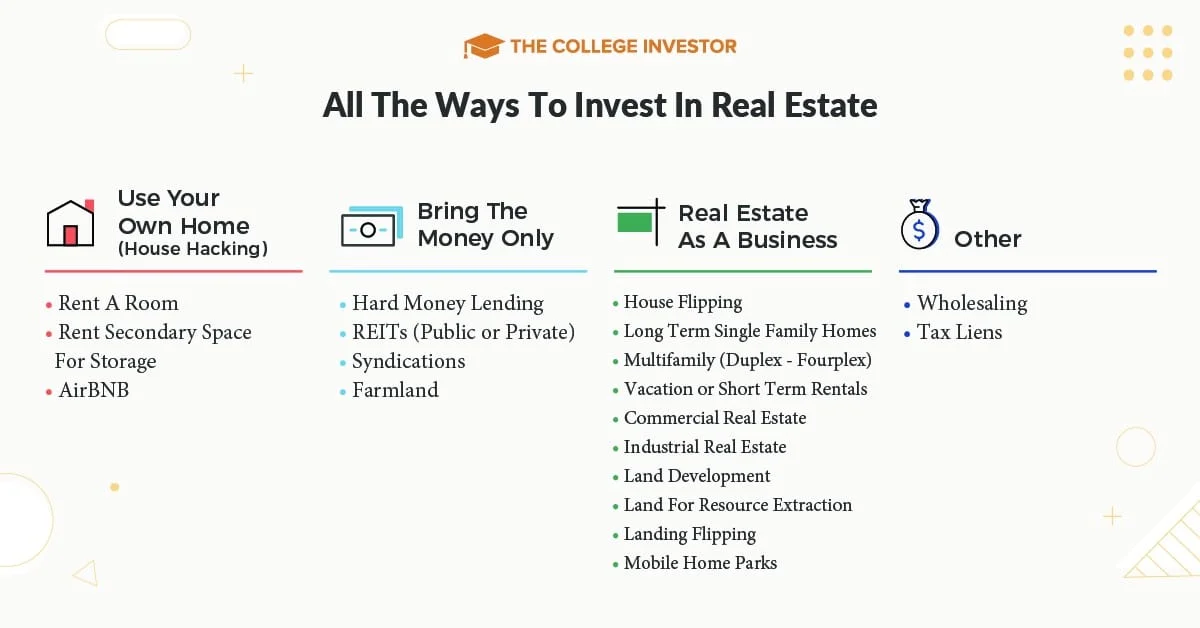
Build Wealth Beyond Your Portfolio
Real estate can add another route toward a million-dollar net worth, but access and liquidity matter. Crowdfunding platforms let you participate in larger property deals with a few thousand dollars; compare minimums and fees in our ranking of the best crowdfunded real estate platforms. If you prefer a rental home, online marketplaces sell single-family properties with tenants already in place. Roofstock built its business around that model, though it now focuses more on institutional buyers and property management. Read our Roofstock review first. And keep money you may need within five years out of illiquid property deals; a high-yield savings account is a better fit.
Let a Business Add to Your Savings
A business can produce wealth faster than saving from a paycheck alone, though it brings uncertainty and work. Some people who became millionaires by 25 built businesses; a huge company isn’t required. Bloggers, YouTubers, and side hustlers have grown personal interests into million-dollar enterprises, often starting with only a few hundred dollars a month in extra income. Our guide to the best side hustles compares options by earning potential and flexibility, and our side hustle ideas can help you choose a starting point.
At 25, the illustrative target is about $381 a month at a 7% annual return. A side income that covers that amount can leave your regular paycheck available for other needs. Earn more, and investing the surplus could shorten the timeline or help build passive income streams that continue after the active work ends.
Set a Goal That Accounts for Inflation
A million dollars is a useful milestone, but its purchasing power will depend on when you reach it. At 3% annual inflation, $1 million in 2066 would buy roughly what $307,000 buys today. Matching today’s $1 million in purchasing power would take about $3.26 million then. Try different assumptions with the inflation calculator.
That gap doesn’t make the savings goal pointless; it means the number shouldn’t be mistaken for a retirement plan. Under the common 4% first-year withdrawal guideline, a $1 million portfolio would provide $40,000 before taxes in that first year. Whether that covers your needs depends on spending, Social Security, and retirement timing. Compare your savings with retirement savings benchmarks by age.
As your income rises, raising your monthly contributions can help your savings keep pace with prices. You can also see how your finances compare with average net worth figures for millennials by age.
Account for Taxes Before You Count the Million
The balance on a statement doesn’t tell you how much you’ll be able to spend. Traditional 401(k) and IRA contributions generally go in before tax, with withdrawals taxed as income; Roth contributions are made after tax, and qualified retirement withdrawals are tax-free. Our Roth versus traditional IRA decision tree can help you weigh the options.
Many people end up with both kinds of accounts. Employer matching contributions may also go into a traditional account even when your own contributions are Roth. For 2026, Roth IRA contribution eligibility phases out at incomes of $153,000 to $168,000 for single filers and $242,000 to $252,000 for married couples filing jointly, according to the IRS. For the broader savings plan, see how to save $1,000,000.
Planning to retire before 65? A taxable brokerage account may help bridge the years before retirement accounts are easier to access. Most withdrawals from a 401(k) or IRA before age 59½ face a 10% penalty, subject to exceptions. Our retirement savings order of operations explains how to prioritize accounts.
Questions Readers Often Ask
How much should I save each month to reach $1 million?
Assuming a 7% annual return and a goal of reaching $1 million by age 65, the estimate is about $381 a month starting at 25, $820 at 35, $1,920 at 45, or $5,778 at 55. The table above also shows estimates at 5%, 8%, and 10%. Enter your own age and balance in our millionaire calculator.
How long would it take if I maxed out my 401(k)?
Contributing the 2026 annual maximum of $24,500 and earning 7% would grow a zero balance to roughly $1 million in about 20 years. Employer matching could reduce that time. See the retirement savings order of operations for guidance on what to fund first.
Can someone earning $50,000 become a millionaire?
Yes, over a long enough period. A 6% contribution from a $50,000 salary, paired with a typical match of 50 cents per dollar on contributions up to 6%, adds $375 a month to a 401(k). At 7% for 40 years, that would grow to about $984,000; future raises could make up the difference. Our 15 ways to save $500 a month offers ideas for finding more room in your budget.
Is $1 million enough to retire?
Using the 4% planning guideline, $1 million supports about $40,000 in first-year withdrawals. But at 3% inflation, that million dollars 40 years from now would have the purchasing power of roughly $307,000 today. Your spending and retirement date matter. Check retirement savings benchmarks by age.
How many people have at least $1 million in a 401(k)?
Fidelity reported 769,000 401(k) millionaires on its platform at the end of June 2026, up from 654,000 the previous quarter. Those are Fidelity accounts only, so the figure doesn’t represent a national count. Our best IRA accounts ranking covers options beyond a 401(k).
What return should I assume when planning?
A 7% annual return is a planning assumption for a stock-heavy portfolio, not a promise. The S&P 500 returned about 10% annually from 1928 through 2025, including dividends, and its weakest 40-year period still averaged about 8.5%. Fees, bonds, and inflation can reduce what an investor actually earns. Our Rule of 72 explainer shows how different rates affect the time it takes to double money.
Final Thoughts
Reaching $1 million usually comes down to a monthly contribution, an account suited to your goal, and enough time for compounding to work. Start with an employer match, consider an IRA, and use additional income to close the gap. Starting earlier lowers the monthly amount required, as the compound interest math makes clear. The harder question is whether a nominal million will be enough for your future expenses.
Readers, what do you think? Could most people save $1,000,000 if they made it a priority?
Editor: Clint Proctor. Reviewed by: Chris Muller.
The post How To Make $1,000,000: The Monthly Savings Math By Age And Return appeared first on The College Investor.