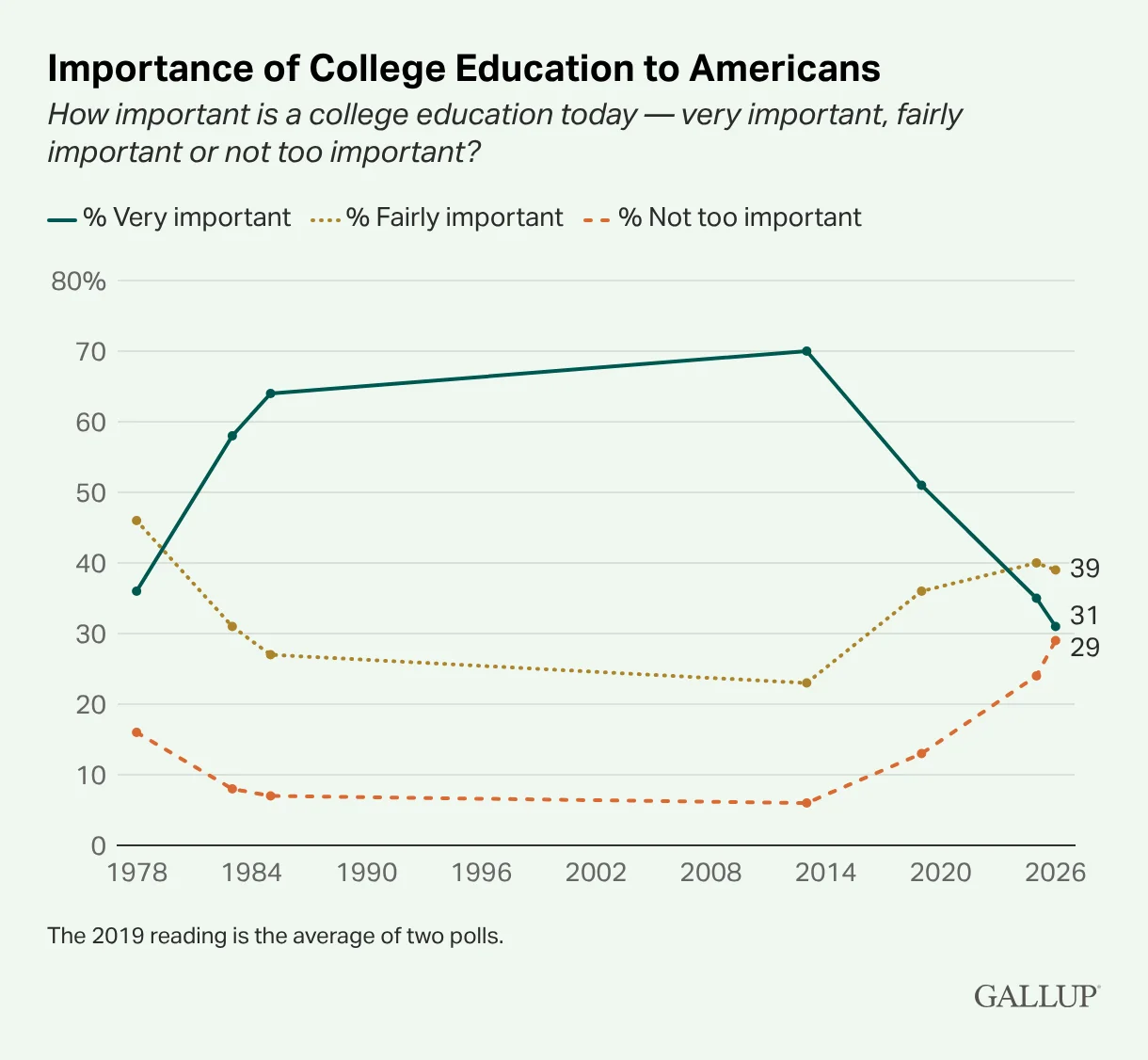
The perceived value of a college education has returned to a level last seen nearly five decades ago. In Gallup’s latest poll, 31% of U.S. adults say college is “very important,” down from 35% last year and 70% in 2013. The current reading is also below the 36% recorded when Gallup began asking the question in 1978. That shift adds weight to the debate over whether a degree justifies its cost.
The trend is striking because it reflects a change in how people rate college as a broad social priority, not simply a dip from one poll to the next. A lower rating doesn’t establish that Americans have stopped valuing education or that a degree has lost its economic benefits. It does suggest that the public is less willing to treat college’s importance as self-evident. For families facing a major expense, that distinction matters: the case for enrolling increasingly has to be weighed against the cost and the likely payoff.
The change is visible across the full range of responses. The share calling college “not too important” rose from 6% in 2013 to 29% now, while “fairly important” increased from 23% to 39%. The distance between the strongest supporters and skeptics has narrowed from 64 percentage points to just two. For households comparing tuition with likely returns, that’s a marked change in the public mood around the financial payoff of a degree.
That shift from “very important” toward “fairly important” is telling. Many people may still see some value in college, while reserving judgment about whether it deserves top priority for everyone. The poll measures attitudes, not the quality of individual programs or graduates’ earnings, so it can’t settle whether a particular degree is worth its price. But the numbers here are underwhelming for institutions that rely on a broad public presumption that college is essential.
Affordability weighs on perceptions
Cost offers a clear part of the explanation. In a recent Lumina Foundation-Gallup survey, only 12% of U.S. adults said a four-year college education was affordable. That assessment comes as college costs have risen and student loan balances have reached $1.86 trillion nationally.
Those findings help explain why abstract support for college can weaken even when families continue to consider it. A degree is a long-term commitment, while tuition and borrowing costs arrive much sooner. People also have to weigh expenses they can see against returns that vary by program, institution, and career path. The poll doesn’t show which factor is decisive for each respondent, but a broad affordability concern puts pressure on the claim that college is automatically a sound choice.
Gallup’s comparisons also show that declining enthusiasm reaches beyond any one demographic. Between combined June 2019 polls and combined August 2025 and 2026 polls, the share saying college is very important fell by double digits among women, middle-aged and older adults, Democrats, Black and Hispanic adults, and college graduates. In 2019, a majority in each of those groups had rated college very important.
A decline among graduates is particularly revealing: firsthand experience doesn’t insulate people from doubts about the cost or the institution’s wider role. Still, the figures describe group-level opinion and don’t explain why individuals changed their views. For parents weighing how to manage college expenses, the result suggests that doubts about affordability and value now span a broad range of households. (And this is the part most people overlook.) Skepticism can spread even among people who believe education helped them personally.
Public skepticism and personal plans diverge
Views are more favorable among people with direct experience of higher education. The Lumina Foundation-Gallup State of Higher Education Study found that 73% of adults without a degree or credential consider earning a two- or four-year degree at least as important as it was 20 years ago. The figure among college graduates is 69%.
These responses don’t directly contradict the latest importance poll, since the questions measure different things. One asks how important college is to the country; the other asks whether earning a credential matters to the respondent, compared with two decades ago. That gap can capture a familiar distinction: people may question the system’s value in general while continuing to see education as useful for their own prospects.
Parents’ preferences show a similar split: most say they’d like their child to pursue a two- or four-year degree after high school, according to Gallup’s survey of parents. People may be less certain about college as a broad social priority while still seeing it as a path for their own families. That tension sits at the heart of the discussion over college as an investment.
For a parent, the practical question is rarely whether education has any value; it’s whether a particular route is worth its cost for a particular student. What this means for you depends on the program, the price, and the goals attached to it. A poll can describe the public mood, but it can’t make that household calculation.
Enrollment will show whether attitudes shift behavior
The latest importance measure follows Gallup’s July finding that confidence in higher education was 38%, down from 57% in 2015. The two readings point to a wider loss of faith in the sector, though public opinion alone doesn’t show whether students are changing course.
Confidence and perceived importance are related, but they aren’t interchangeable. Someone can doubt whether colleges are serving the public well and still pursue a degree for career access, personal development, or family expectations. That’s why polling is an early signal, not a direct count of decisions. A change in sentiment may precede changes in enrollment, or it may coexist with continued demand.
Enrollment counts for fall 2026, FAFSA filings for the 2027-28 school year, and early participation in Workforce Pell will offer useful signals. Those measures may show whether the declining public ratings are translating into different education choices, as borrowers respond to student loan changes in 2026.
Each measure answers a different question. Enrollment can show whether students are entering higher education; FAFSA filings can indicate how many are seeking federal aid; Workforce Pell participation can offer a view of interest in another education route. None, by itself, explains why a person chose a path or whether it will pay off. The useful test will be whether several indicators move in a direction consistent with the polling, and whether the pattern persists.
The next test is whether choices change
Here’s the thing: a weaker public rating matters most if it changes decisions. For colleges, it raises the burden of explaining what students receive for the time and money they commit. For families, it reinforces the need to compare the cost of a degree with the purpose it is meant to serve. And yet, continued interest among prospective students and parents shows that skepticism hasn’t erased college’s appeal.
The evidence points to a more conditional public judgment. Americans appear less inclined to call college essential across the board, while many still want credentials for themselves or their children. That’s a meaningful change in the terms of the debate, but it isn’t proof that enrollment will fall or that degrees have stopped paying off. The next indicators will show whether public doubt is becoming a change in behavior. For now, the gap between general skepticism and personal plans is the story.