How to Position Before the Oil Cushion Hits Empty
The oil reserve numbers are more than a gauge of today’s supply. They show how much protection the U.S. and Europe have left if another disruption hits—and that buffer is shrinking while investors watch the Middle East headlines. Eric Fry, editor of Fry’s Investment Report, argues that the pressure on oil supplies is one reason to pay attention to the companies building new power capacity.
In 1999, the Great Lakes cargo ship Hope I lost generator power after its crew dismissed a low-fuel alarm. They planned to refill later, but no diesel had reached the generator’s service tank. The chief engineer also doubted the tank was as low as the warning suggested. The ship lost steering and ran aground near Morrisburg, Ontario.
That story offers a useful analogy for the current oil picture, though the circumstances are different. The U.S. Strategic Petroleum Reserve holds roughly 285 million barrels, its lowest level since October 1982. That’s about 40% of its authorized capacity of roughly 714 million barrels. The concern is not simply that the reserve has fallen; it’s that policymakers may be counting on a cushion that’s thinner than it appears.
For investors, the question is what could happen if oil flows are disrupted again—and which energy sources can help meet demand while the reserve buffer remains low.
What the reserve drawdown signals
U.S. crude and fuel exports have stayed near record highs since spring, helping offset lower supplies from the Middle East. That has helped contain oil prices, but it has also reduced available inventories.
Combined U.S. and European crude reserves have fallen 16% since March, according to the article’s chart, and the decline has continued month by month. The figure includes strategic reserves. At 886 million barrels, combined stocks amount to roughly one month of U.S. and European consumption. That’s a limited backstop if global crude flows suffer a more serious interruption.
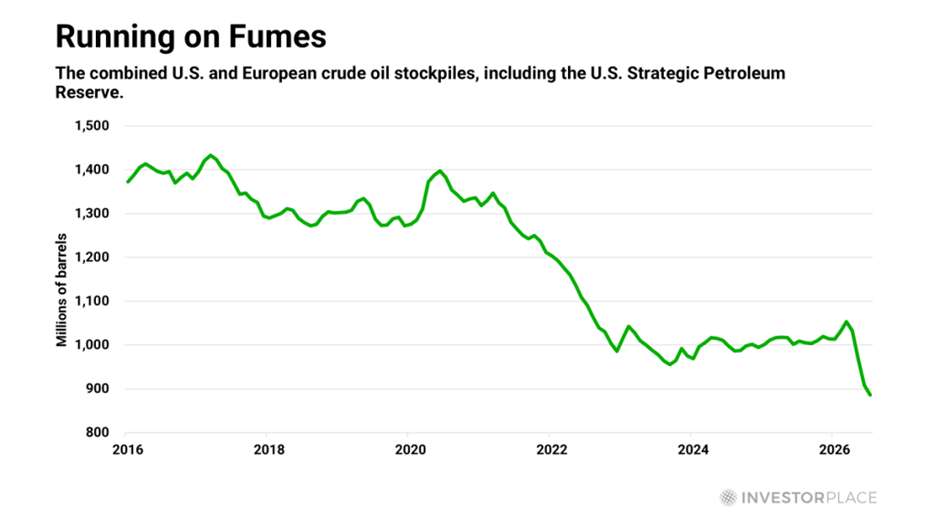
Other inventory measures add to the concern. U.S. oil stocks have declined through the summer, and storage at major hubs such as Cushing, Oklahoma, is nearing the minimum operating level. Diesel supplies are at their lowest seasonal level since 2003, leaving the East Coast exposed as winter approaches.
Prices have already shown how quickly events can change the picture. After drone attacks prompted Saudi Arabia to shut its East-West pipeline on September 11, Brent crude rose above $108 a barrel and West Texas Intermediate topped $103. U.S. crude had not traded above $100 since May. A 60-day U.S.-Iran ceasefire also ended in August without producing a lasting agreement.
Here’s the thing: the reserve data doesn’t tell us whether another supply disruption is coming, or how long one might last. But with inventories low, a fresh shock could push prices higher. The West is relying in part on tanker traffic returning to normal before the available buffer runs down further. That may happen. It’s a thin margin for error.
Why investors are watching alternatives
The reserve drawdown is only half the story. Fry’s investment case is that companies developing renewable power may benefit as businesses look for ways to reduce their exposure to future oil shocks and meet rising electricity demand.
The U.S. is expected to add nearly 85 gigawatts of power capacity over the next year, with roughly 90% coming from solar, wind and batteries. Natural gas, still the country’s largest energy source, accounts for 9% of planned new capacity.
The shift has practical drivers. AI data centers require large amounts of electricity; solar and battery projects can be built in months, while new gas turbines may take years to arrive. Data centers can also put unusual strain on gas turbines, and new nuclear plants won’t add significant capacity for years. In that context, renewables are among the fastest and cheapest tools available to add power.
The scale of investment is substantial: green energy, efficiency and water management together make up a $10 trillion global industry. Cleantech companies raised $60 billion in equity funding in the first half of this year, the strongest six-month period since 2022. Those figures point to investor interest, though they don’t by themselves establish which companies will turn that funding into lasting returns.
How Fry frames the investment opportunity
Fry says renewable energy stocks have been producing market-beating gains. He cites two positions added to the Fry’s Investment Report portfolio last year: a solar recommendation up 35% since February 2025, compared with a 26% gain for the S&P 500, and a wind recommendation up 27% over its time in the portfolio.
Those returns are a snapshot of two recommendations, not a guarantee of future performance. Fry’s broader thesis spans both sides of the energy squeeze: constrained oil supplies and the push to build renewable capacity. If you’re considering the trend, the key question is whether a company can meet demand and generate durable returns—not just whether its sector is attracting capital.
For the complete portfolio and Fry’s latest energy research, learn how to join Fry’s Investment Report.
The crew of the Hope I expected to refill its tank later. By then, the ship was already in trouble. The oil reserve figures don’t predict the same outcome for energy markets, but they do make the cost of waiting harder to dismiss.
Regards,
Eric Fry
P.S. Small-cap stocks are having an unusual year. Fry’s colleague Louis Navellier and Marc Chaikin are scheduled to discuss the market’s potential winners and losers on September 29 at 10 a.m. ET, ahead of Election Day. Save a free seat for their Midterm Mayhem event.
About the Analyst
Eric Fry, editor of Smart Money, looks for broad trends that can drive sustained moves across market sectors. His approach focuses on opportunities he believes Wall Street’s conventional analysts may overlook. You can learn more about Eric Fry.
The article was printed from InvestorPlace Media at https://investorplace.com/smartmoney/2026/09/how-to-position-before-the-oil-cushion-hits-empty/. ©2026 InvestorPlace Media, LLC.