What an NFL Legend Can Teach You About Small-Cap Stocks
The investing lesson in Tom Brady’s draft story isn’t that every overlooked player becomes a star. It’s that the biggest winners can be hard to spot before the crowd catches on—and the same can be true of small-cap stocks.
That comparison matters now because smaller companies, after years behind the market’s biggest names, have begun to outperform. Louis Navellier, Editor of Growth Investor, argues that improving earnings and low relative valuations could give the move room to continue. The case deserves a closer look, though a broad rally won’t make every small company a winner.
In the 2000 NFL Draft, teams chose 12 quarterbacks. Chad Pennington became a capable starter before injuries cut his career short. Marc Bulger made multiple Pro Bowls. Chris Redman spent much of his time as a backup; Tee Martin saw limited playing time and later coached. Giovanni Carmazzi never appeared in a regular-season NFL game, and Spergon Wynn lasted two seasons.
Then there was Tom Brady, picked 199th overall and seventh among the quarterbacks. The six quarterbacks selected ahead of him didn’t become Brady. He went on to play in 10 Super Bowls and win seven, becoming one of the most accomplished players in NFL history.
Teams had film, workout results and statistics to study. What they couldn’t reliably identify was which prospect would become a legend. The parallel for investors is straightforward: plenty of information doesn’t guarantee that the eventual standout will be obvious early.
For several years, investors crowded into familiar mega-cap stocks while smaller companies lagged. Now that balance may be shifting. In this Market 360, Navellier makes the case for why small caps are moving, what may be driving them and where he sees potential opportunities. He and fellow investor Marc plan to discuss their market outlook at the Midterm Mayhem event on September 29. Reserve a spot here.
Small caps spent years behind the market leaders
It wasn’t hard to see why investors favored the largest companies. The so-called Magnificent Seven—Apple Inc. (AAPL), Microsoft Corporation (MSFT), Alphabet Inc. (GOOG), Amazon.com, Inc. (AMZN), NVIDIA Corporation (NVDA), Meta Platforms, Inc. (META) and Tesla, Inc. (TSLA)—delivered a large share of the market’s gains.
In 2023, those seven stocks generated more than 62% of the S&P 500’s total return. They contributed more than half of the index’s gains in 2024, too.
Small caps fell behind. The Russell 2000 returned 15.2% in 2023, versus 24.2% for the S&P 500. The following year, it gained 10%, while the S&P 500 rose 23.3%. Small caps lagged again in 2025.
That stretch left the market’s attention fixed on the biggest names. Yet a weak index showing doesn’t mean every company in the group is weak. Navellier says he continued to find individual small-cap stocks that rose even while the category trailed.
He reports that one of his premium services now has nine small-cap recommendations with gains of at least 100%, including one that has gained more than 800%. He credits his quantitative system, Stock Grader, with helping identify those stocks. Those are results he cites for his recommendations; they don’t establish that small caps as a whole have performed similarly.
The group is beginning to outperform
As of Monday, the Russell 2000 was up 15.9% year to date, compared with a 13.4% gain for the S&P 500. That reversal is notable after several years of underperformance, but the figures alone don’t tell us whether it will last.
Navellier points to earnings expectations. He says the small- and mid-cap companies he recommends have average forecast earnings growth of 189.8% and average forecast sales growth of 67.5%. For comparison, FactSet estimates 28.9% earnings growth for the S&P 500 in the third quarter.
Those projections are striking, although forecasts can change and the comparison doesn’t by itself show how much of the expected growth investors have already priced in. Navellier’s central belief is that earnings growth is a key driver of a stock’s long-term prospects. When profits rise, stock prices often follow, though the relationship isn’t guaranteed.
His view: the current small-cap advance may have further to run.
Why Navellier sees room for more gains
Recent outperformance doesn’t necessarily mean small caps have caught up. Navellier points to two measures that, in his view, suggest the group still has ground to make up: relative valuations and its share of the U.S. stock market.
He describes small-cap valuations as near a 25-year low. According to FactSet, the Russell 2000 trades at about 85% of the valuation of the Russell 1000, an index of larger stocks. The historical average is close to 100%, meaning investors are currently paying less for small-cap operating earnings relative to those of large companies.
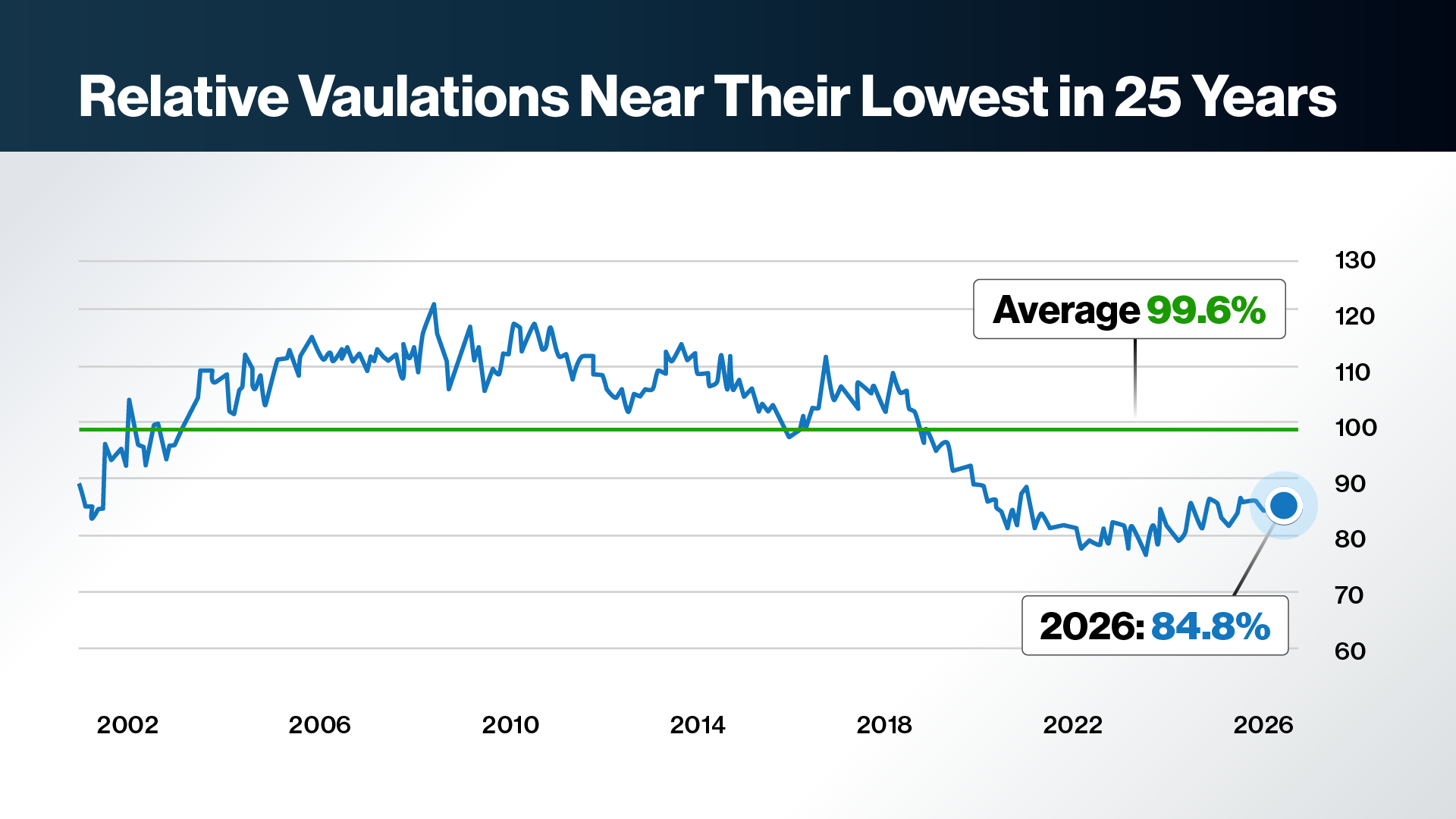
Small caps also account for about 4% of the U.S. stock market today, compared with a historical figure closer to 9%. That gap, paired with stronger expected earnings, is the foundation of Navellier’s bullish case.
There’s a reasonable argument here: a group that’s outperforming while trading below its historical relative valuation could have more upside. But neither measure guarantees a long rally. Navellier argues that small-cap bull markets can last years rather than weeks, and that the current move may be near its beginning.
Finding the winners early is the hard part
Brady’s career is a memorable reminder of how difficult it can be to identify a future star. It’s also a reminder that most overlooked prospects don’t become Tom Brady. The same caution applies to small-cap investing: a rising index doesn’t make every company in it a sound investment.
Navellier says he and Marc will share their view of what may come next for the market, discuss why small caps could benefit and explain how investors might prepare at the 2026 Midterm Mayhem Event on September 29. The event is presented as a way to hear their analysis; investors should still assess individual stocks and their own circumstances before acting.
Save your seat for the 2026 Midterm Mayhem Event.
Sincerely,

Louis Navellier
Editor, Market 360
The Editor discloses that, as of the date of this article, he directly or indirectly owns securities discussed or mentioned in the commentary, analysis, opinions, advice or recommendations below:
Apple Inc. (AAPL), Alphabet Inc. (GOOG) and NVIDIA Corporation (NVDA)